Synchronization: From Zero to 5G
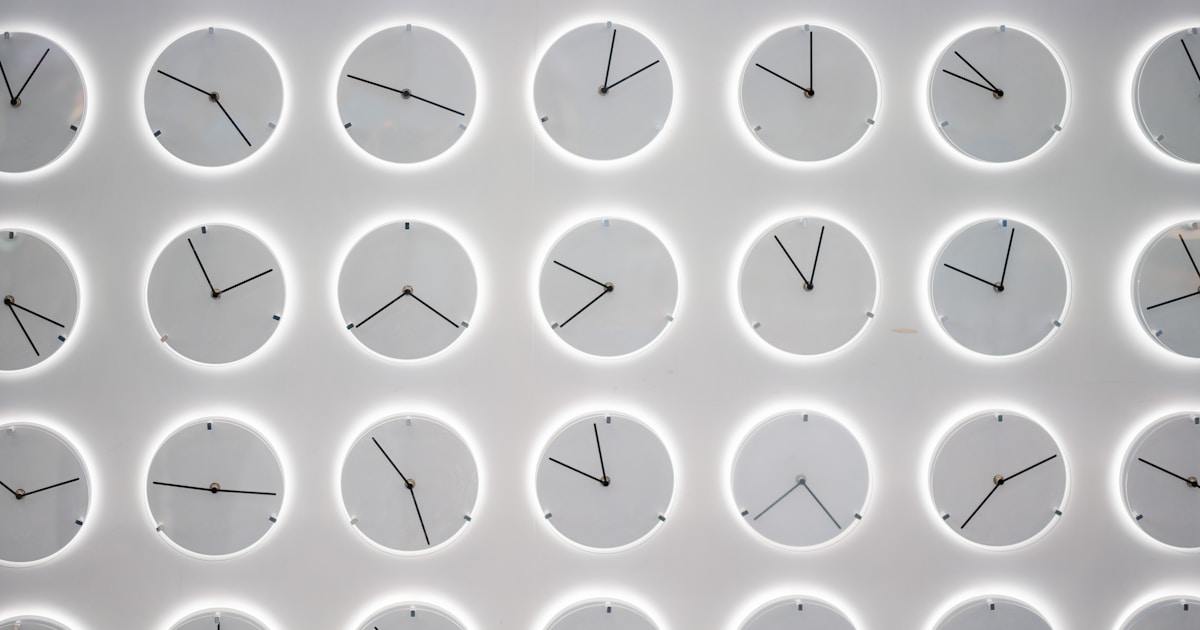
How have the various synchronization challenges been solved? What is the impact of the arrival of 5G?
If you have watched older films (and not-so-old ones) in which a group of people devises a plan for a heist, the scene where they gather beforehand to synchronize their watches should be familiar. If you also owned a non-smart watch, you are well aware that this synchronization is necessary for three reasons: each watch is set manually, likely using different references, and above all, each one introduces a different drift that accumulates over time, to the point of falling behind by several seconds or even minutes over the course of a month.
That is a problem from another era. Nowadays, if I want to know the time, I look at my phone or smartwatch and have no doubt it is the exact time. This was achieved by correcting the three problems mentioned: the time is no longer set manually, different references are no longer used, and natural drifts in each system are now constantly corrected.
However, despite these adjustments and the precision we require as users when checking the time, there are functionalities that demand even greater precision. What are these applications? How have the various synchronization challenges been solved? What is the impact of the arrival of 5G?
Basic Precision for End Users
The solution to the first problem (manual adjustments) is straightforward: the adjustment is made automatically through the network, thereby eliminating human error at the moment of synchronization. But where does the network obtain the time? This is answered by the solution to the second and third problems: the standardization of protocols that use a reference clock to distribute the time through the packet network.
In the case of our devices, this standardization takes the form of NTP (Network Time Protocol). NTP uses primary servers to receive the reference time for synchronization. That reference can be obtained from a cesium clock, from another NTP system, or from a Global Navigation Satellite System (GNSS); the most common is GPS, owned by the United States. Some of its counterparts are GLONASS (Russia) and Galileo (European Union). In this way, the use of a single reference is resolved, while the drift problem of each device is addressed by querying the time at regular intervals and adjusting the difference.
NTP primary servers send the signal to secondary servers through the telecommunications network, which then distribute it to clients (the devices). Each hop between servers and nodes to reach the client adds a small delay to the clock signal, caused both by the propagation time of the clock signal (delay) and the difference between clocks (offset). These delays cause NTP clients to receive the time with a precision that may differ by up to several milliseconds.
This precision is more than sufficient to know whether I am on time for a meeting or whether I need to take the food out of the oven, which is why the NTP solution is appropriate for use in end-user devices, but the same cannot be said for all applications.
The Need for Precision in Telecommunications Networks
When we discuss telecommunications networks, there are functionalities that require much greater precision than milliseconds. Let us explore an example: wireless communication using the TDD (Time Division Duplex) technique, present in some LTE systems and in 5G.
To understand it, let us first discuss its alternative: FDD (Frequency Division Duplex). The fundamental requirement is that, in the data exchange between your device and the internet provider's radio station (the radio base station), there must be a way to download data (from the base station to the device) and another to upload data (in the reverse direction). Using FDD, a downlink channel is reserved at one frequency and an uplink channel at a different frequency, so both communications can occur simultaneously.
What TDD does to separate uplink from downlink is divide time into small windows and assign some of them to uplink and others to downlink. This improves spectrum efficiency, since a single channel is used, in addition to providing the ability to dynamically allocate resources to uplink or downlink based on demand. Its main challenge lies in the precision with which the radio base stations mark the beginning of these windows.
Cellular coverage in an area is achieved by deploying base stations separated into smaller regions. Given that the transmission power of base stations is high enough to reach all devices in their region, it is expected that the transmission from one base station will be received by a neighboring base station.
What would happen if one of the base stations had its clock offset by, for example, an entire TDD window? What one station interprets as downlink could be received by its neighbor as uplink, generating significant interference in the network.
How Do We Achieve More Precise Clocks?
To remedy clock offsets when the required precision is greater, the PTP (Precision Time Protocol) was standardized and began to be implemented for LTE systems. PTP enables clock synchronization in distributed systems with high precision using a master-slave approach, in which a master clock sends time signals to slave clocks through the network. The slave clocks adjust their local clocks to stay synchronized with the master clock.
The master, similarly to the NTP primary server, obtains the reference signal for time synchronization from a GNSS receiver. This may raise the question: why use PTP to distribute through the network if I can receive a GPS signal from any base station? The question is not only valid but gives rise to an existing synchronization solution on the market, called GNSS Everywhere.
Although it has the advantage of not losing precision by not having to propagate, its main disadvantage is the possibility of losing the GNSS satellite signal due to bad weather or poor line of sight between the base station and the satellites. If a base station loses the signal, it can begin to interfere with all adjacent base stations and must therefore be taken offline.
In contrast, PTP clocks have a high-precision internal oscillator with which they can maintain the clock signal for hours or even days after ceasing to receive the GNSS signal, making them robust against circumstantial reception issues. Additionally, GNSS reception is centralized at a few points that are then distributed across the network, without requiring receivers at each node and thereby reducing costs.
What Changes with 5G?
With NTP, we discussed a precision of milliseconds. In 3G, the precision requirements establish a maximum error of 10 microseconds (an order of magnitude a thousand times smaller). In 4G or LTE, it is 5 microseconds. In 5G, the maximum error that base stations can have without generating interference is 1.5 microseconds from the clock signal to the base station transmission, including all intermediate hops.
The conditions are more restrictive than ever due to the new technologies enabled by the 5G paradigm. The substantial reduction in the time each communication takes across the network (latency), the use of highly directional transmission techniques for each mobile user (beamforming), and the increase in frequency resources to improve the bandwidth of a communication (carrier aggregation) are examples that raise the bar in terms of synchronization and translate into a better user experience and, overall, a significant advancement in telecommunications.
Precision requirements are increasingly demanding, and this makes synchronization systems a fundamental component for network operation, both in telecommunications and in other systems (including utilities). That is why it is necessary to rely on synchronization solutions that meet these requirements to ensure smooth and reliable connectivity. Additionally, the vulnerabilities generated by dependence on GNSS signals must be addressed, but that is a topic for another article.
By Pablo Bertrand, Support Engineer Analyst at Telcos.
Pablo is an Electrical Engineer specializing in telecommunications and a Master's student in Electrical Engineering at Universidad de la República. He has more than 7 years of experience in the telecommunications field and performs functions in pre-sales, implementation, and project support.
Paysandú 926CP 11100MontevideoTel: +598 2902 1477
© 2025 Isbel S.A., una marca Quantik®
Av. Ana G. Méndez 1399, km 3PR 00926San JuanTel: +1 (787) 775-2100
Carmen C. Balaguer 10El Millón, DNSanto DomingoTel: +1 (809) 412-8672
Síguenos
Nuestras Políticas