Smart Poles: Infrastructure for the Cities of the Future
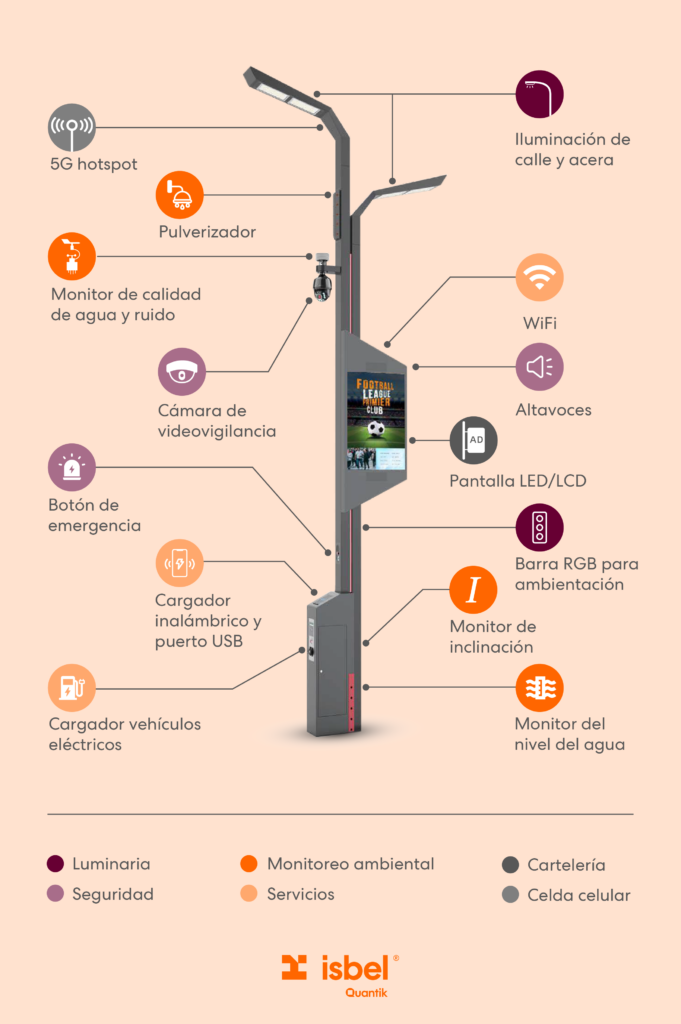
When it comes to installing a new pole, today we can choose a smart alternative that integrates all the aforementioned devices into a single unit, without additional effort or cost.
New Ways of Thinking About Our Cities
Urban infrastructure has always played a crucial role in our cities. Every construction project has a dual impact on citizens: we are pleased when a street is freshly paved, but we endure the inconvenience when achieving that requires road closures, machinery noise, and the various forms of pollution that come with it.
Today, cities feature infrastructure deployments for video surveillance, lighting, signage, information displays, public content broadcasting systems, and more. These devices share something in common: they are usually mounted on poles.
The Evolution: From Torches to Smart Poles
Poles for lighting have existed since the earliest times, so to speak, from the first torches and oil lamps to electric lights. But let us stay on topic. The point is that the concept of smart poles began to emerge in recent years.
Naturally, with the expansion of connectivity and the development of the Internet of Things (IoT), the first evolution of poles was to add intelligence to the lighting system. These smart systems consist of a central station from which luminaires and their status are managed, on/off schedules are programmed, and the most advanced versions even include activity sensing and dynamic brightness adjustment.
With the arrival of urban video surveillance systems, the simplest approach was to place them on existing poles. This was very practical in some respects, but it certainly did not take the aesthetics of the infrastructure into account. It involved placing large enclosures on top of the poles, which became frequent targets of vandalism.
Thus, with surveillance systems and other equipment that was subsequently added, even though it was unrelated to the original function, the concept of the smart pole as we know it emerged. That is, a device designed to house different types of equipment in a harmonious and simple manner, all controlled from a single central system.
A Closer Look at Smart Poles: What Components Do They Have and What Services Do They Offer?
By definition, a smart pole features a steel column designed to support and install various devices, as well as an interior compartment where power and connectivity are distributed to the equipment that can be installed. To achieve this, the pole contains a computer responsible for interacting with the devices, processing information, and sharing connectivity.
As for the devices, today poles are equipped with the following:
-
Smart luminaire Smart luminaire
-
Wi-Fi AP Wi-Fi AP
-
Camera Camera
-
Display screen Display screen
-
Weather station Weather station
-
Cellular small cells Cellular small cells
-
Speakers for content broadcasting Speakers for content broadcasting
-
Emergency call button Emergency call button
-
AC charger for electric vehicles AC charger for electric vehicles
The Role of Smart Poles in 5G Infrastructure
In the list above, one element may attract particular interest, especially for telephone operators: the ability to serve as infrastructure for a 5G radio base station.
The cost of deploying a site for a telco, whether using its own infrastructure (poles, towers) or third-party infrastructure (building facades, rooftops), is significant. Combined with the fact that future 5G deployments will require a higher density of access points, the possibility of housing a 5G cell on these poles becomes a highly attractive option.
One country that has already adopted this approach is Japan. In the city of Tokyo, the Tokyo Data Highway strategy was defined in 2020, which involves installing smart poles with the premise of hosting 5G cells for multiple operators.
Additional Applications: What Other Areas Can Benefit from This Technology?
The concept of smart poles is far from being limited to cities alone. Today, many private campuses (belonging to corporations, universities, shopping centers, and others) choose to deploy smart poles internally.
For these "small cities," this solution covers all their needs, whether implemented from scratch or by upgrading the poles they already had in place.
Smart poles make it possible to unify all systems within the same infrastructure solution and management platform. This eliminates the need for separate systems for lighting, CCTV, digital signage, and dedicated cellular infrastructure on top of existing building infrastructure.
A Future-Proof Investment
The future holds rapid advances in these technologies, which continue to add new functionalities on a daily basis. The installation of smart poles will bring a vast range of applications and devices that we will see emerge over the years, an investment grounded in planning and cost savings.
Countries such as Spain, the United States, Australia, Japan, and even Colombia in our region are already deploying this type of system.
Jose Luis Nunes, Product Line Manager IoT & Smart Cities.
Joselo is an electrical engineer (Telecommunications) from Universidad de la Republica.
He has been part of Isbel for 8 years, with a career spanning more than 6 years in the after-sales area.
Paysandu 926CP 11100MontevideoTel: +598 2902 1477
© 2025 Isbel S.A., a Quantik® brand
Av. Ana G. Mendez 1399, km 3PR 00926San JuanTel: +1 (787) 775-2100
Carmen C. Balaguer 10El Millon, DNSanto DomingoTel: +1 (809) 412-8672
Follow us
Our Policies