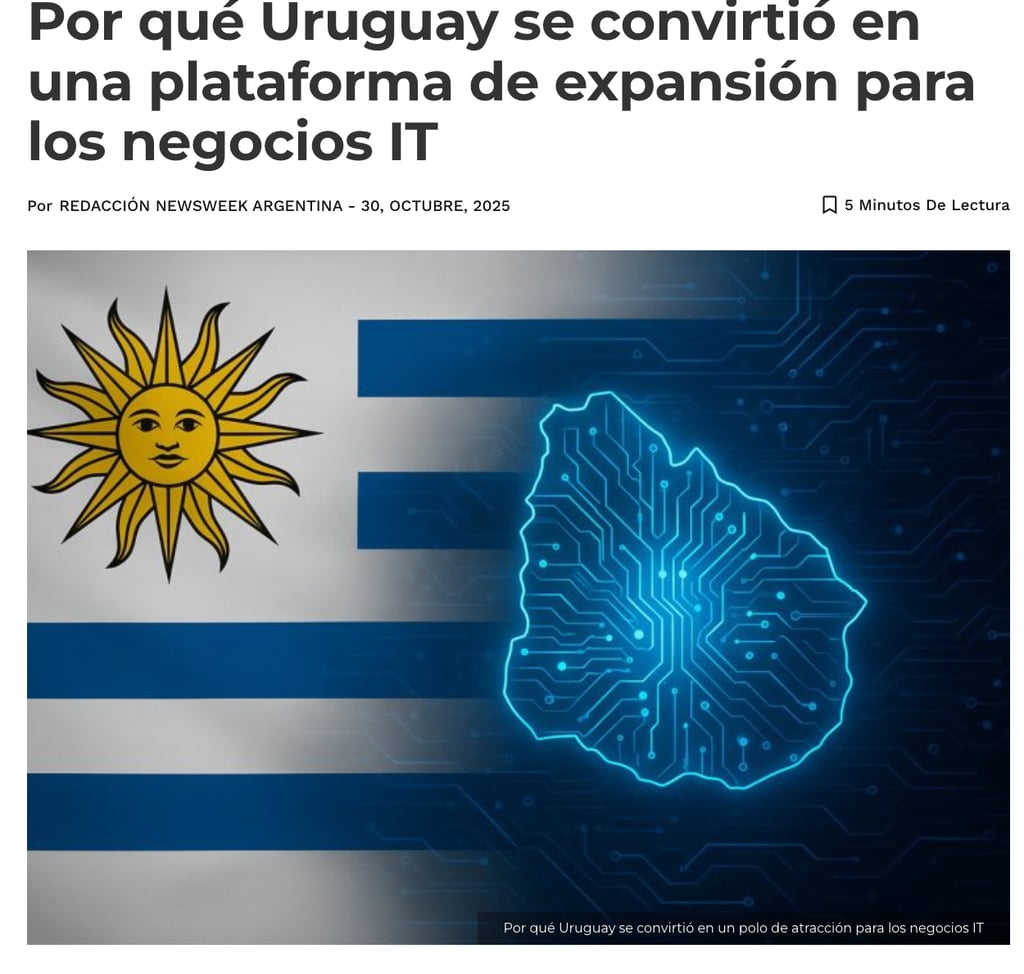
Why Uruguay Became an Expansion Platform for IT Business
By Rafael Staricco for Newsweek Argentina
Over the past 40 years, Uruguay has developed two new industries. The forestry industry on one hand, and the technology industry on the other. But what explains how a country can become so competitive in a sector of the economy while being so small? The same question could be asked about football, perhaps. The answer is simple: ecosystem. It is not just about territory, but about a fabric of services, skilled human resources, companies, collaboration networks, and stable public policies.
Innovating quickly, as is well known, is as important as innovating well. Countries that manage to combine regulatory agility, institutional stability, and specialized talent become true laboratories for technology. New solutions -- from applied artificial intelligence to smart meters and new alternatives in electric mobility transportation -- can be developed, tested, and scaled with a global vision.
The Information Technology (IT) sector has been climbing positions in the Uruguayan economy, with a total impact close to 4.5% of the Gross Domestic Product (GDP) and the generation of more than 20,000 direct quality jobs. It is currently one of the country's five main export sectors, with annual revenue exceeding US$ 3.5 billion.
Several factors explain this development, and there are plenty of examples of companies and startups of various scales that innovate from Uruguayan soil to reach Latin American markets and more distant ones such as Saudi Arabia or Germany. Not to mention the solid commercial relationship with the United States and the United Kingdom, of course.
On one hand, the well-known institutional stability provides a solid guarantee framework for establishing businesses or planning investments over longer time horizons. In fact, last year, Uruguayans achieved progress in international positioning with the Nation Brand. According to the Nation Brand Report, prepared by Brand Finance, Uruguay reached a brand value of US$ 65.8 billion, representing a 14% increase over the previous year and positioning it at number 70 in this global ranking. Along the same lines, the International Monetary Fund highlighted this year the institutional stability and resilience of the Uruguayan economy, amid a global environment of uncertainty.
This growth is certainly not accidental. The Uruguayan State has been an active player in the development of the digital ecosystem and has been investing for more than a decade in infrastructure, connectivity, and public policies aimed at digital transformation.
Programs such as Plan Ceibal, the digitalization of public services, and the open government agenda form the foundation for a knowledge-based economy. The same applies to the relationship between the private sector and the State through organizations such as the National Agency for Research and Innovation (ANII), Uruguay XXI, and the Uruguayan Chamber of Information Technology (CUTI), which function as internationalization platforms with collaborative frameworks that enable co-creation of solutions, exploration of opportunities, and anticipation of regulatory scenarios.
Thinking about technology can be a vehicle, but also a common language. An increasing number of solutions are born in Uruguay and implemented directly in international markets, and this growth is further accelerated by the exponential potential that AI offers for the development of tech products.
Beyond the traditional models of exporting development hours, the design of technology services with a distinctive identity is growing. In particular, SaaS (Software as a Service) platforms have gained prominence: these are applications that operate from the cloud, with the ability to scale rapidly, reach multiple countries without physical barriers, and continuously deliver added value. This is an example of what it means to compete with mature proposals, ready to integrate into global operations, and to position oneself as a value creator in an environment that changes at speeds never seen before.
Turning small scale into a strength allows for rapid reaction and organization to innovate. The Uruguayan "sandbox" makes it possible to effectively implement collaborative projects due to the proximity and access to key players, enabling the "testing" of solutions applied from the country to the world.
Challenges? Of course there are, but there is also an ecosystem that learns, adapts, and responds. It is time to think about revolutionizing industries, scaling ideas, and generating sustainable impact. It may be that, on the new digital map of the region, size does not define reach, but vision does.
Access the full article here.
Paysandu 926CP 11100MontevideoTel: +598 2902 1477
© 2025 Isbel S.A., a Quantik® brand
Av. Ana G. Mendez 1399, km 3PR 00926San JuanTel: +1 (787) 775-2100
Carmen C. Balaguer 10El Millon, DNSanto DomingoTel: +1 (809) 412-8672
Follow Us
Our Policies